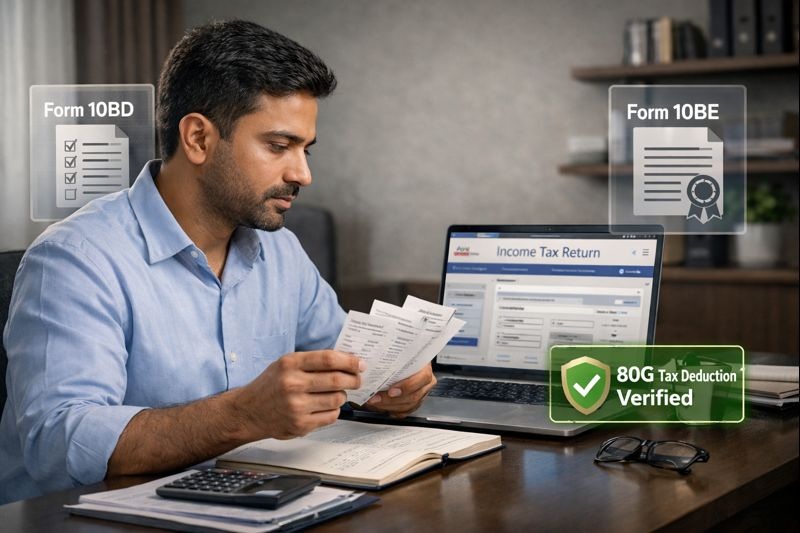
80G Tax Deduction Explained in 25 Powerful Insights Every Indian Taxpayer Must Know Before Filing ITR
80G Tax Deduction – The Complete Truth Every Taxpayer Must Know
Stop scrolling for a moment.
If you have donated even one rupee to a charitable trust and claimed a tax benefit without fully understanding the law, you could be risking denial, notices, or loss of deduction.
The 80G tax deduction is one of the most powerful yet misunderstood provisions under the Income Tax Act, 1961, and knowing it correctly can protect both your money and your peace of mind.
This authoritative guide decodes Section 80G exactly as prescribed by law, explains how the Income Tax Department verifies your claim, and shows how donors silently lose benefits due to small but costly mistakes. Every explanation below is grounded entirely in statutory FAQs and official clarifications issued under the law.
What Section 80G Really Means Under the Income Tax Act ?
Section 80G exists to encourage charitable giving while allowing taxpayers to reduce their taxable income legally. It permits a deduction while computing total income when a taxpayer donates money to certain notified funds, trusts, institutions, or government-backed causes. However, this deduction is not automatic, unlimited, or universal.
The structure of Section 80G is carefully layered. Sub-section (1) determines how much deduction can be claimed and introduces a formula-based approach. If donations include special notified funds, a portion qualifies for 100 percent deduction while others qualify for 50 percent. If donations are made only to other eligible institutions, the deduction is restricted to 50 percent.
Sub-section (2) acts as the master eligibility list, specifying every fund, institution, and authority that qualifies. Sub-section (4) introduces the critical concept of a qualifying limit, while sub-section (5) lays down strict eligibility conditions for institutions themselves.
Understanding the Core Difference Between Donation and Deduction
Many taxpayers confuse donating money with receiving a deduction. A donation is simply the act of giving money to a charitable entity. A deduction, however, is the tax relief granted by law only if the donation meets every statutory condition.
This distinction matters because even a genuine donation can be disallowed if the donee is not eligible, if the payment mode is incorrect, or if reporting requirements are not fulfilled. The tax benefit exists only within the framework of Section 80G and nowhere outside it.
Who Is Considered a Donor and Who Is a Donee ?
Under the law, the donor is the person or entity making the donation. This includes individuals, Hindu Undivided Families, firms, companies, or any other taxpayer with taxable income. The donee is the trust, fund, or institution that receives the donation and must be approved under Section 80G.
This relationship is now digitally tracked. What the donor claims in the return must exactly match what the donee reports to the Income Tax Department. Any mismatch can automatically disqualify the claim.
Who Can Legally Claim the 80G Tax Deduction ?
Any taxpayer with taxable income who donates to an eligible institution can claim the deduction. This includes salaried individuals, professionals, businesses, and corporate entities. There is no minimum income threshold, but the deduction is meaningful only if tax is payable under the old tax regime.
Taxpayers opting for the new tax regime under Section 115BAC are explicitly barred from claiming the 80G tax deduction, regardless of the donation amount or purpose.
The Four Legal Categories of Donations Under Section 80G
The law classifies donations into four distinct categories based on deduction percentage and limits. Some donations qualify for 100 percent deduction without any cap, while others qualify for 50 percent without limit. Certain categories attract a qualifying limit of 10 percent of adjusted gross total income, beyond which no benefit is allowed.
Understanding this classification is non-negotiable. Claiming a deduction without identifying the correct category is one of the most common reasons for denial during processing.
Donations That Qualify for 100 Percent Deduction Without Any Limit
Certain national and government-backed funds enjoy the highest level of tax incentive. These include the National Defense Fund, Prime Minister’s National Relief Fund, PM CARES Fund, Clean Ganga Fund, Swachh Bharat Kosh, National Sports Development Fund, National Cultural Fund, and several others listed exhaustively in Annexure-1. View FAQs released by ITD
Donations to these funds allow full deduction of the donated amount without any ceiling, subject only to proper reporting and payment mode compliance.
Donations Eligible for 50 Percent Deduction Without Limit
Some notified funds, such as the Prime Minister’s Drought Relief Fund, qualify for a 50 percent deduction without any qualifying limit. However, several sub-clauses were omitted by the Finance Act, 2023, making updated verification essential before claiming.
This reinforces the importance of not relying on outdated lists or assumptions when filing returns.
Donations With Deduction Subject to the 10 Percent Qualifying Limit
Donations made to government bodies for family planning, approved sports infrastructure development, and certain charitable institutions fall under categories where deduction is restricted to 10 percent of adjusted gross total income.
Any excess donation above this threshold is ignored entirely for tax purposes, even if the donation itself is genuine and eligible.
Cash Donations and the ₹2,000 Rule That Many Ignore
The law strictly prohibits deduction for cash donations exceeding ₹2,000. Payments must be made through cheque, draft, or electronic modes. Even a single rupee above this limit in cash renders the entire amount ineligible for deduction.
This provision exists to prevent misuse and ensure audit trails. Ignoring it is one of the fastest ways to lose the deduction.
One Donation, One Deduction – No Double Claims Allowed
Once a donation is claimed under Section 80G, it cannot be claimed under any other provision of the Act. This applies across years as well. Attempting to double-claim exposes the taxpayer to adjustments and penalties.
This rule ensures fairness and prevents overlapping tax benefits.
How the Income Tax Department Verifies Your 80G Claim ?
Verification now happens digitally through Form 10BD filed by the donee institution. This form captures donor PAN or Aadhaar, name, address, and donation amount. The donor receives Form 10BE as proof.
If your ITR claim does not match Form 10BD data, the deduction can be automatically denied. This makes documentation and verification non-negotiable.
Adjusted Gross Total Income Explained Clearly
Adjusted Gross Total Income is not your total income. It is calculated after excluding deductions under Chapter VI-A (except 80G), exempt income, certain capital gains, and special rate incomes.
This adjusted figure determines the qualifying limit for certain donations and directly impacts how much deduction you can actually claim.
Why Donations in Kind Never Qualify ?
Only monetary donations are eligible. Donations in the form of goods, services, or assets, regardless of value or intent, are explicitly excluded under the law.
This rule eliminates valuation disputes and standardizes compliance.
What Happens If the Donee Loses 80G Registration ?
If the donee institution’s 80G approval expires or is cancelled, donations made after that date become ineligible. The responsibility lies with the donor to verify validity during the relevant assessment year.
Blind trust without verification can cost you the entire deduction.
Claiming 80G in the ITR – What the Law Requires ?
Claiming the deduction requires accurate reporting under Chapter VI-A, entering correct donee details, donation amount, and eligible deduction. Missing PAN, incorrect registration number, or mismatch with Form 10BD can invalidate the claim.
Precision is no longer optional; it is enforced digitally.
Why Excess Donations Cannot Be Carried Forward ?
Unlike losses or some deductions, excess donations above qualifying limits cannot be carried forward. Any unclaimed portion is permanently lost for tax purposes.
This makes planning and category identification crucial before donating.
The Psychological Trap of “Good Intentions”
Many taxpayers assume that good intentions guarantee tax benefits. The law does not operate on intention but on compliance. Emotional giving without legal awareness often leads to denial, disappointment, and notices.
Understanding the framework protects both generosity and financial discipline.
Why This Knowledge Matters for Your Financial Future ?
Proper use of the 80G tax deduction allows you to support causes you believe in while strengthening your financial position. Misuse or misunderstanding, however, leads to wasted donations from a tax perspective.
Knowledge transforms charity into a strategic, compliant, and future-secure decision.
Visit Income Tax Department Website.
Client Advisory
Techmin Wealth Partners advises taxpayers to verify eligibility, documentation, and reporting requirements before claiming deductions under Section 80G. While charitable giving is socially valuable, tax benefits are governed strictly by statutory provisions and digital verification mechanisms. Professional review ensures compliance and avoids future disputes.
Disclaimer – Techmin Wealth Partners
Techmin Wealth Partners is a registered business consultancy firm engaged in business, tax, and compliance advisory services. This article is intended solely for educational and awareness purposes regarding income tax provisions related to charitable donations.
Techmin Wealth Partners does not promote or encourage donations for tax avoidance purposes. Tax deductions under Section 80G are subject to strict conditions, eligibility, and verification by the Income Tax Department. Readers are advised to consult qualified tax professionals before making donation or filing decisions. This article does not constitute legal, tax, or financial advice.
Techmin Wealth Partners is your one-stop solution for all your tax and business needs. Those who wish to take their business or compliance planning to the next level may contact us for professional support and guidance.
Comment “80G HELP” if you want personalised assistance.
Save and share this post to avoid costly mistakes during ITR filing.
On LinkedIn, repost this to help your network stay compliant and informed.

